Those were just two of the building blocks within a new framework that Sapiens developers said was necessary to inject in order to meet new needs: skills had become the new currency of growth, turning capabilities into the terms of trade in the human market. I found myself thinking, more and more, that just having skills didn’t cut it. Being successful today, I think, involves having a broader tool kit – a tool kit that allows me to transform obstacles into stepping-stones, and even open doors to opportunities I could not previously have seen. In a constantly changing world, the definition of success is now shifting under our feet. This insight hit me like a bolt of lightning—an inflexion point hiding in plain sight. As I made my way through challenges and opportunities alike,
What Does Building Capability Mean?

Capability building is the endowment or accumulation of the required skills and knowledge that make the org/un-org agile and resilient [1]. It is more than just training because it includes long-term development, the ability to solve problems and ongoing improvement. Building capabilities enables teams to address current needs and, more importantly, to face future challenges with confidence, and is thus a key enabler of enduring excellence in today’s competitive landscape.
A New Mindset: Choosing Capability Over Quick Results
Over time, I realized that chasing quick results does not always lead to real progress. Success that comes too fast can disappear just as quickly. That is why I started focusing on building capabilities instead. By improving my skills, knowledge, and thinking, I am creating a stronger foundation for my future. This shift in mindset has helped me understand that true growth takes patience, learning, and consistent effort.
Learning Today to Grow Tomorrow
Building capabilities means investing in myself every day. Whether it is learning something new, improving existing skills, or gaining experience, each small step contributes to long-term growth. I have learned that when you focus on development rather than immediate results, success becomes more sustainable. This approach allows me to adapt to challenges and keep improving over time.
From Short-Term Wins to Long-Term Strength
In the past, I often focused on short-term achievements, but now I understand the value of long-term strength. Capability building helps me become more confident, more adaptable, and better prepared for future opportunities. Instead of just aiming for quick wins, I am now focused on developing abilities that will support my growth for years to come. This personal shift has made my journey more meaningful and purposeful.
The Importance of Building Organisational Capability
Developing the capabilities of the organisation is a prerequisite for sustained resilience, efficiency and innovation in an ever changing business environment. Well‐capable organisations can more readily bring their people, processes, technology, and other resources into alignment to effectively execute their strategic goals. This leads to improved decisions, increased employee engagement, and more robust leadership pipelines.” Finally,” When all is said and done,” building organisational capability lays the groundwork for stable performance and long-term competitive advantage.
What Is the Importance of Capability Building?
The value of capacity building is that it enables organisations and people to be prepared for the future. Through continuous learning and development of skills, companies can address gaps in performance, increase productivity, and proactively respond to changes in the industry. Capacity building creates a culture of adaptability and accountability where teams are not only prepared to run complex challenges, but are also innovation and growth contributors.
Overcoming Common Challenges to Building Capability
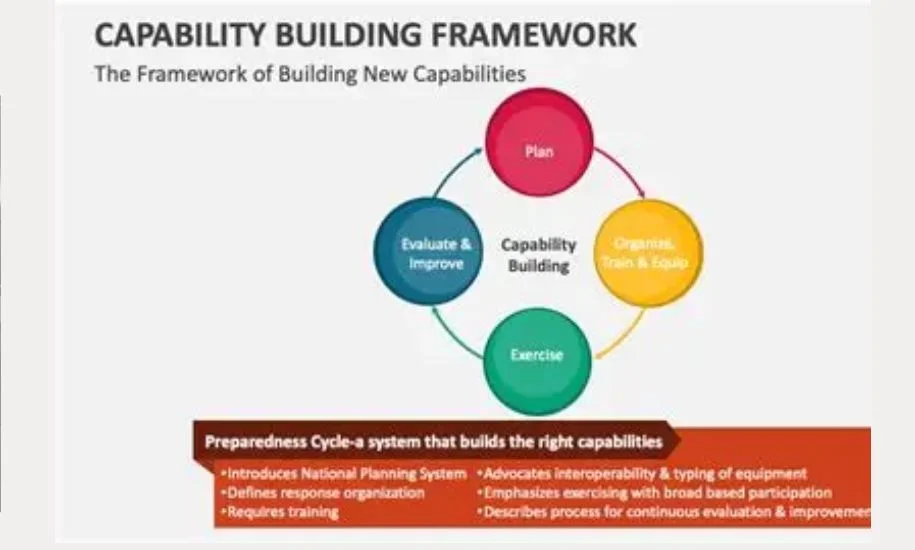
Addressing the common barriers to capability building requires strategic thinking and planning, strong leadership commitment and an understanding of what the organisation needs to do. Typical barriers such as resistance to change, resource constraints and misalignment can be overcome with focused training, communication and quantifiable objectives. When learning is integrated into the daily work and is coupled with collaboration, organisations can effectively manoeuvre through barriers and develop sustainable capabilities.
Capacity vs. Capability
Capacity and capability are two different things, often confused with one another. Capacity is the number of tasks or workload a person or company can handle, while capability is about how well the work is done. A company might have the capacity to handle more work, but if it doesn’t have the necessary capabilities — the skills, experience, and systems — it will have trouble producing good results. You need to have both capacity and capability for sustainable success.
Participation in Professional Networks
The Professional network is important for enhancing capabilities and sharing knowledge because the network can share, collaborate and learn. Participation in professional networks is a queuing rather than an individual-based process. Looking out for representatives of one’s own industry also keeps one informed as to the latest standards of work, developments and tools of the trade. Networks also offer mentorship and contribute to innovation, making them an exceptional means of building excellence organizationally and individually.
Skills Are Not Enough Anymore — Calitpabies Are the New Currency
Each capability has become a body of knowledge that we can draw on in different ways to respond to the need to flex, if you will. Skills alone often seem like mere stepping stones, rather than solutions, in today’s world. They are important , yes, but their inflexibility can make it very difficult to apply them to real-world problems. Skills are more than a level of competence in one area — they include flexibility, critical thinking, emotional intelligence, creativity, and a willingness to change your mind. It’s like having a Swiss Army knife versus a single tool.
My own turning point occurred in a seemingly routine meeting. At first, the conversation seemed to be just an ordinary one, but quite soon it veered into the unexpected. A colleague shared thoughts on the importance of adapting to change and welcoming uncertainty, and their message deeply connected with me. Life is filled with moments of change disguised as everyday moments. We’re busy rushing through our days, focused on immediate tasks, not realising when we might be faced with one of those subtle incidents that can alter our lives dramatically.
A Turning Point Hidden in Plain Sight
With shifting industries and emerging technologies, relying on what skills you have alone can put you at a disadvantage. Knowing something is not enough; doing something with that knowledge and doing it in new and different ways is what separates those who perform from those who struggle. Taking on this wider lens helps open up unexplored terrain for application. Unforeseen opportunities present themselves to those who cultivate, who change, who are in perpetual motion. Critical thinking, collaboration and an ongoing culture of innovation — that’s what really makes the world go ‘round, today.
That was my flashpoint—that moment when I woke up to the fact that the old skills were going to be insufficient in a swiftly changing terrain. I understood that developing capacity was a more viable route, that it readied one for the known as well as the unknown – the predictable as well as the unpredictable. This change in outlook wasn’t limited to my career; it bled into my personal life, as I found myself questioning the way I tackled both obstacles and opportunities. It changed the way I thought about growth.
Captabilities Turn Problems Into Growth Pathways

Through developing skills and gaining knowledge, we grow stronger and more resourceful. This attitudinal change helps us to better manage uncertainty and to view delays as a way of receiving feedback to move in directions that are more promising, rather than as obstacles to progress. The process of adversity can build not only the individual but the team. Each capacity is built on another, leading to solutions you might once have thought were impossible. What started out as a ceiling of constraint becomes a platform of growth and creation.
Every problem has a hidden opportunity. This is the essence of transforming challenges into routes of development. Our first responses when we encounter barriers are often anger or despair. Nonetheless, it is in these moments that potentials are realised. They help us face challenges differently and literally transform our view of obstacles into stepping stones rather than barriers. It is an opportunity to reinvent and evolve on every problem.
The Early Roots of a Caplitabiy Mindset
CapabiliSense promotes a culture where people become aware of their unique abilities and best equip themselves to face challenges. It cultivates the exploration of learning opportunities in dance with barriers, transforming potential hindrances into avenues for growth. The road to a capability mindset often starts with one simple insight: in a world that’s constantly changing, skills aren’t enough. In the course of my work, I noticed there were a few people. They were not only talented artists—they were flexible, resourceful, and incredibly fast at learning new things in situations where they had no idea what they were doing.
CapabiliSense is not just a framework, but a transformational model of personal and professional growth. The approach is about being capable, not just having the skills. Skills might be inflexible, but capabilities are mobile and elastic.
How CapbiliSaense Works (The Vision)
dventurous, and brave with the support of a community, enabling them to view change as a friend. And serves as a beacon, leading the way to smarter growth with deliberate capability development. This vision challenges us to rethink what is possible when we emphasise adaptability and lifelong learning. As I thought about my own beginnings, I remembered a few such times. Reacting to unforeseen difficulties or jumping on unexpected possibilities, these people seem to have had an unusual ability to turn on a dime. This underlying mentality isn’t natural for everyone, but it can be developed. A readiness to tolerate pain, ambiguity, and to keep learning turns the soil in which one grows. Capabilities are not static tools, but rather dynamic resources that enable us to navigate personal and professional challenges.
The process has closed loops built in, so there can be real-time adaptations to the plan and how it is carried out. CapabiliSense nurtures individuals to be curious,
Calitpabiy-Buinildg Helps You Lead Better (Even If You Don’t Have a Title)
People want to know what it is like from the perspective of individuals with ability, flexibility, or problem-solving skills. Leadership is not a function of title or position, but it is a function of mutual influence, mutual impact, and the mutual ability to lead others well. Building capabilities enables individuals to lead from where they stand. Having the right capabilities makes the difference.
Leadership is a job less about command and more about true self and connection. A growth mindset leads to trust, respect and collaboration amongst teams. Leadership is no longer hierarchical and individual but collective and shared when you have everyone building capabilities together. You don’t need a title to make a difference; the right mindset enables anyone to lead powerfully in any situation. Strengthened capabilities empower people to confront challenges, take creative action and lead others in times of ambiguity.
Bulinldig Capiliabties Creates a Personal Competitive Advantage
It’s an attitude and the method of treatment, which enable one to approach all sorts of problems with confidence and imagination. Flexibility, innovation and resilience are traits that employers are valuing more and more. Capabilities also allow for deeper relationships with colleagues, clients, and peers, as recipients of several complex capabilities are better able to engage.
Capability-Building Helps You Serve Others Better
Development-building also increases empathy. Knowing other points of view helps you find customised answers, and you can anticipate needs better. Development investment raises not only the person but also those around them. It is more effective to support when you have a better understanding of strengths and weaknesses. Developed leaders can engage team members more genuinely, building trust, collaboration, and innovation.As someone advances, so does their reach, motivating their peers and followers to embark on their own journeys of growth. This sets off a ripple of collective empowerment, leading to higher service quality and an environment that values team success over individual glory.
The Power of Adaptive Learning
In a time of rapid transformation, adaptive learning provides people with the means to keep growing for the rest of their lives, both at work and in life. Adaptive learning changes the game for skills development. It adapts educational content to learners’ individual needs, thus making the learning process more effective and interesting. An assessment that determines your strengths and weaknesses in real time lets you spend more time on areas that challenge you and less on those where you are already knowledgeable.
This kind of learning builds resilience, flexibility and problem-solving abilities, which are crucial in today’s fast-evolving world. Motivation is more encouraged with adaptive learning as measurable progress and individualised input keep users engaged.
Capliabity-Buding as a Way of Life
Capability-building is seamlessly interwoven with living life, and its challenges become stepping stones to growth, that is, sustainable growth in every area of life. Building capabilities is not just a plan to improve skills; it is a way of life that continues to evolve. When learning becomes a part of life, everyday experiences become chances to learn. Each project, interaction, and challenge helps build capabilities.
This lifestyle fosters curiosity, receptivity to feedback, and dedication to ongoing enhancement. Innovation is sparked, and understanding deepened through contact with different viewpoints.
The Framework Behind the Philosophy
Looking to the future, there is a future power in which capabilities dominate. This future is about developing a nimble mindset that can keep up with fast change. Workplaces will live and die by teamwork, as varied strengths coalesce to transform complexity into opportunity. Education will be transformed to include critical thinking, emotional intelligence, and life-long learning as essential components in its core curricula. Technology will serve as the enabler for adaptive learning and individualised development paths. Those people and organisations that welcome capability-building today will be those who can flourish in the unknown and reach the fullest of their capabilities.
A Vision for the Future
This combined system enables the building of capabilities that are personally relevant and meaningful, and that increase effectiveness across a range of situations. At the core of capacity building is a strong theoretical and practical framework. Awareness is the foundation: being aware of your strengths and weaknesses enables you to focus your development. Experimentation promotes new ways of doing things, learning from success as well as failure. Collaborating expands viewpoints, promotes creativity, and increases the ability to solve problems. Reflection integrates all the components of the process, and consolidates learning and informs future action.
Final Thoughts
Building capacity is a journey of transformation, not only in how one views problems and possibilities, but in what it means to grow as a person. It builds a culture of grit, flexibility, and continuous learning. This journey is both a personal empowerment, as well as empowerment of relationships, the team, and our greater potential. You’re making every step count towards a full life. Developing your capabilities means developing new ways to look at the world, to behave deliberately, and to view growth as an ongoing path.
Conclusion: The Journey That Builds the Person
Developing capabilities is not just a matter of professional accomplishment; it is a personal transformation. Every step forward in development makes people of them, makes them more creative, and gives them new and unknown power. Education in company with others is certainly a boon for teamwork and group advancement. When you take on a capacity-oriented attitude, you become an ever-evolving entity that views barriers as prospects, and you have the ability to enhance your community through valuable influence.
FAQs About CapabiliSense
- What exactly does CapabiliSense mean?
CapabiliSense is the awareness of the significance of having capabilities and doing things to build them up in your life and work, and the meaning of Capabilities in the areas of Personal Growth, Professional Development, and Leadership Effectiveness. It translates capabilities into meaningful actions that enable enduring success. - Why are capabilities more important than skills?
Skills are useful for completing tasks today, but Capabilities are what equip you to face the challenges of tomorrow. They ripen adaptability, resilience, and critical thinking in a world that is always changing. - How can I start building my own capabilities?
Start by pinpointing areas in which you can improve. Have well-defined objectives and participate in lifelong learning activities that stimulate your thought processes and enhance your capabilities. - Can anyone develop a mindset?
Yes. And if you are ready to change, and willing to put in the time to learn, and take a proactive approach, you too can develop a capability mindset. - Is there a specific framework for devties?
Self-awareness, goal-setting, adaptive learning, mentorship and reflection combined together – this makes a very powerful framework for developing capabilities.
About the Author